Attilio Bixio — 1st Place, Landscape
An interview with Attilio Bixio
GLPA 2025 Winner Interview
Attilio Bixio — 1st Place, Landscape
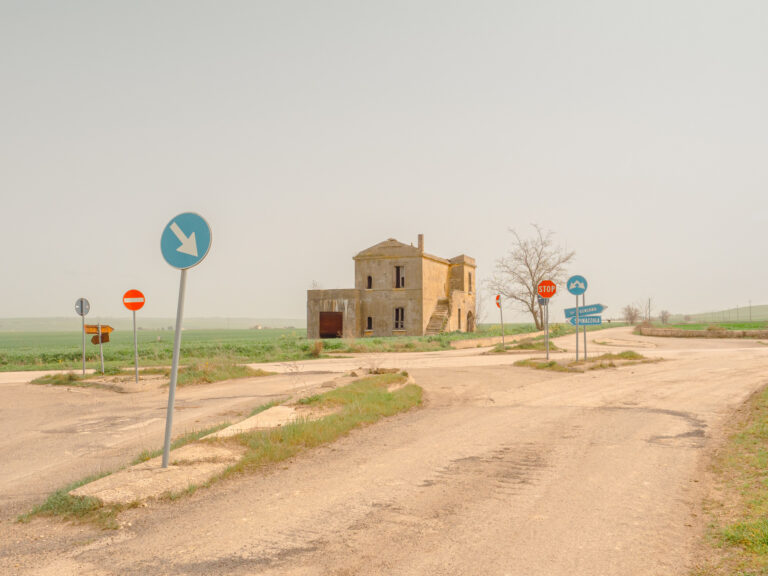
Regina Viarum
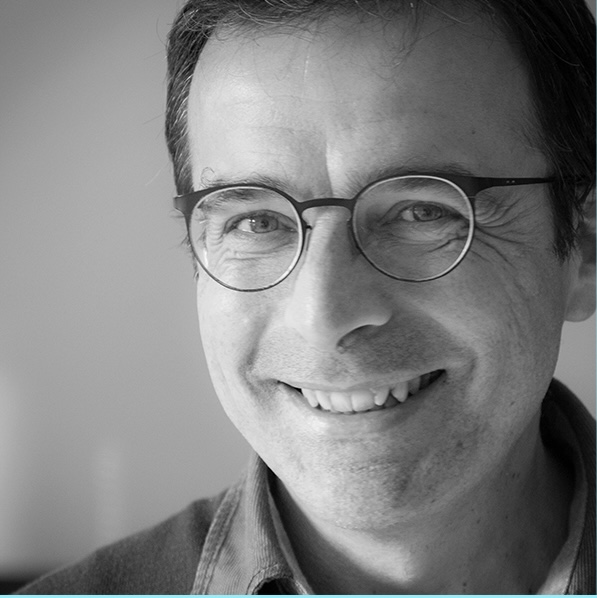
We’re pleased to feature Attilio Bixio, winner of 1st Place in Landscape at the Global Lens Photography Awards 2025.
Based in Potenza, Italy, Attilio approaches the man-altered landscape with an engineer’s precision and an artist’s patience,
reading places as living archives of human dreams, failures, and time. In Regina Viarum, he follows the Via Appia Antica
through Basilicata—where Roman history, UNESCO recognition, and the traces of a 1950s land reform meet in a quiet, desolating harmony.
1) You describe the Via Appia Antica as partially visible and abandoned, in a “desolating harmony” with the surroundings. What did you feel when you first encountered these places?
I had been thinking for long time about photographing the places crossed by the Via Appia Antica, the Regina Viarum of the ancient Romans.
The opportunity arose during a workshop with Italian photographer Silvia Camporesi, to whom I shared my idea for this project. Actually,
before visiting these places in person, I first decided to study them on a map and explore them virtually on Street View. For this reason,
when I encountered them for the first time in person, in a certain sense it was as if I already knew them, even though, seen and experienced
in person, the places reveal much more, because they are experienced not only by sight, but by smelling their scents, hearing their sounds and
noises, experiencing their heat or cold.
2) Your work focuses on the man-altered landscape and the traces people leave behind. What kind of “human presence” interests you most—ruins, geometry, infrastructure, or something more subtle?
Actually, my main interest in human-altered landscapes goes beyond the way they look today; I’m more intrigued by what they can tell us:
any place, if you know how to read it, can tell you about its past, stories that have happened there, and the people who lived there, with their
dreams and dramas. That is what interests me most: imagining the invisible stories that intertwine between walls, streets, and countryside,
anything that makes a place lived in and shaped by time and people.
I have a very slow approach to photography: stopping, observing, and listening to what a place has to say, creating images that aim not only at
beauty, but also at curiosity, reflection, and empathy towards the environments and people who inhabit them.
3) This project connects Roman history, UNESCO recognition, and the failed land reform of the 1950s. How did you balance historical context with visual simplicity in your images?
In my opinion, the visual representation of a place that has experienced many historical phases must necessarily be concise, to avoid distractions
caused by elements that could be misleading in relation to the story being told. For this reason, my images generally contain few elements: I am
a firm believer in the principle of “less is more”, removing rather than adding. Too many elements in an image risk distracting from the message
you want to convey through it.
4) As an engineer, you likely see structure, function, and systems differently. How has engineering shaped your way of composing landscapes?
I can’t say exactly how my studies and my profession in engineering have shaped my approach to photography, but there’s no doubt that they have
influenced it in some way, as I believe all my experiences have. As Ansel Adams said, “You don’t make a photograph just with a camera. You bring
to the act of photography all the pictures you have seen, the books you have read, the music you have heard, the people you have loved.”
5) In “Regina Viarum,” the road is both the subject and almost a ghost. Was your intention to document what remains—or to show what has disappeared?
Both: as mentioned earlier, I try to tell the story of a place through its present.
6) What was the biggest challenge in photographing abandonment without turning it into “ruin aesthetics,” and keeping it honest?
In general, I don’t like photos that follow clichés, and in my opinion, the aesthetics of ruins are just that. If you approach a place superficially,
the temptation to turn a photo into a cliché, a stereotype, is always present, but if you try to tune in to what a place has to say, you can obtain
images that convey much more than what places show at first glance. For this reason, in order to reveal the essence of a place, I try to avoid the
rhetoric of postcards and instead focus on the authenticity of the silent stories that emerge through careful observation.
7) Can you share one moment during the project when the landscape “spoke” to you—something small you noticed that changed the way you photographed the series?
I went to photograph these places on a day when the sirocco wind was blowing: the air was full of suspended sand, which created a soft light,
almost without shadows and with little contrast, whereas normally these places are very sunny, with a harsh, unforgiving light that makes you want
to take shelter rather than contemplate. When I encountered this type of light, at first I was almost disappointed, it seemed like an ugly light to me,
but then I accepted the challenge and decided to take pictures anyway, and perhaps this was one of the elements that contributed to the peculiar character
that the series took on.
8) After exhibitions and awards across many countries, what does this GLPA recognition mean to you, and what direction do you feel pulled toward next?
It was a great satisfaction for me to receive this award. I think that the GLPA, although it is a young award, has the potential to become increasingly
established internationally. It was certainly a confirmation that encourages me to continue with my approach to photography.