Mario Schneider — 2nd Place, Street
An interview with Mario Schneider
GLPA 2025 Winner Interview
Mario Schneider — 2nd Place, Street
New York Short Stories
We’re pleased to feature Mario Schneider, 2nd Place in Street at the Global Lens Photography Awards 2025.
His series New York Short Stories reveals a side of the city that often goes unnoticed: quiet, tenderness, reflection, and the fragile warmth between strangers.
Rather than chasing spectacle, Schneider listens for subtler signals—those human moments that carry emotion without announcing themselves.
The result is a body of work that feels intimate, literary, and deeply attentive to the emotional undercurrent of public life.
In a city like New York—often photographed for its energy and intensity—you chose to focus on silence, tenderness, and human affection. What drew you toward those quieter moments?
It is probably in my nature to devote myself to the hidden and the quiet. I often give a voice to those who are not so obvious. How I find them is a mystery to me, as I don’t search for them. Let’s say they find me. It’s as if these quiet moments, these people lost in thought, emit a charm that reaches me, as if someone had fired a shot into the air.
You describe these photographs as “quiet signs in an increasingly noisy world.” What did New York reveal to you over these three years that surprised you most?
It was actually a kind of solidarity that I could feel. I had the feeling that people were looking out for each other. That may have been my imagination, but especially on Coney Island beach, I noticed so many different ethnicities and social classes coming together that it gave me hope that everything could still turn out okay.
Some of the images were made shortly after Donald Trump’s re-election and second inauguration. Did that political atmosphere change the way you moved through the city or read the moments around you?
No. I am not an artist with political concerns. I am always interested in people and how they feel. Of course, ideally, I express the feelings of a society. But for me, that has to happen without pointing fingers politically.
Your title, “New York Short Stories,” suggests each image holds a complete human fragment. How do you know when a street photograph contains a story rather than just an interesting scene?
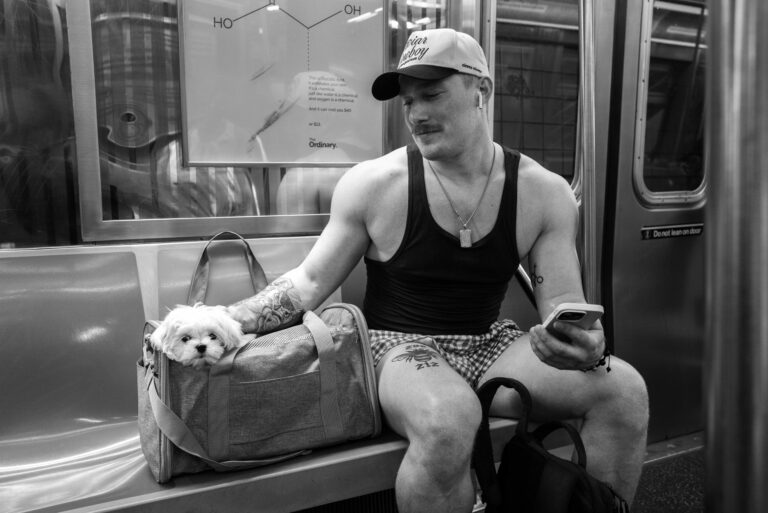
Of course, I don’t really know, since the stories take place in the viewer’s mind and not in the photo. If a photo has the dimension that makes you wonder what happened before or what will happen next to this person or scene, if the photo gives you a glimpse into a life situation, or if a man with a dog in the subway is so close to you that you feel like you know him, then part of the story has been told, and if I’m lucky, the short story begins in the viewer’s mind or heart.
In a place so visually saturated, what helps you recognize moments of real emotional truth?
It’s easy, when it touches me. I always start from myself. That’s the only real way to find or convey emotions, when they reach the artist himself. The rest is a matter of luck, whether it then reaches others as well.
Your work seems to resist cliché while still embracing the myth of New York. Was that balance something you consciously pursued?
I believe that when you pick up on a genuine human emotion on the street, it can never be a cliché because it really existed. It can be anything—boring or even obscene, silly, embarrassing, or uninteresting—but never a cliché.
Your photo book “New York Short Stories” was published by Kehrer Verlag just recently. How did the process of turning this body of work into a book shape your understanding of the series?
Certain photos that belong in the book are emerging. I had help from the publisher and from photographer friends who helped me with the selection. In the end, my wife, Anja Krämer, suggested the sequence with the photos I would like to have in the book. It was a very harmonious process. I am very happy with the book.
What does this GLPA recognition mean to you, and what kind of human moments are you most interested in following next?
I would like to express my gratitude for the award. This honor means a great deal to me, because as a street photographer, one remains quite invisible in the overall photography scene. We street photographers have a difficult position, as it is not possible to earn money with street photography. We capture our present for future generations, which is far too little appreciated in our current times. But I don’t want to complain. On the other hand, I learn so much every day on the street from the people I meet; these are regular gifts that I receive. I am currently working on my new cinema documentary. We are still in the middle of filming. It should be finished in the middle of next year and will be called “Black day is a good day.”