Antonio Denti — Photographer of the Year 2025
An interview with Antonio Denti
GLPA 2025 Winner Interview
Antonio Denti — Photographer of the Year 2025
Global Lens Photography Awards
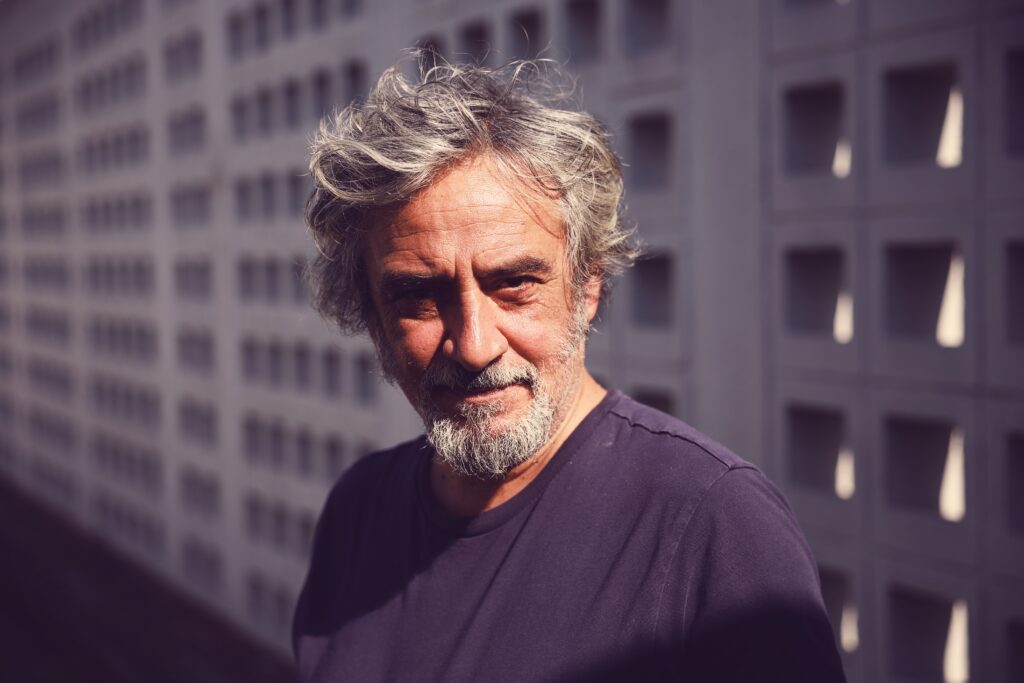
We’re honored to feature Antonio Denti, named Global Lens Photography Awards Photographer of the Year 2025.
An Italian cameraman and photographer with more than two decades of work for Reuters, Denti has documented conflict, migration,
natural disaster, and the fragile persistence of everyday life under extreme conditions. What distinguishes his work is not only
its journalistic rigor, but a way of seeing that remains deeply human, alert to beauty, fear, dignity, and the stubborn force of life.
You have spent more than two decades documenting conflict, crisis, and human displacement. What keeps you emotionally grounded while working so close to history at its most fragile?
The single thing that I love most about photography is that it demands you stand in line of sight with the intended subject of your pictures.
This simple, physical fact carries many important consequences. It forces you to exit your comfort zone and travel into the subject’s world,
to negotiate access to it, to share, to an extent, the subject’s reality — the dangers, the beauty, the smells, the fear, the temperature and food.
But one of the most important outcomes of placing oneself in line of sight with someone is that if I can see them and therefore photograph them,
it will also be possible for them to see me. The need to be able to stand this glance back, humanly, forces you to be clear with yourself,
sorted and strong, on why you are standing there.
My job for decades has been to intrude the lives of others, uninvited, of my own initiative. Often, the lives I was witnessing were lives in crisis,
pain, hardship, terror. It was very important that I could look them in the eyes and be clear on why I was intruding their lives.
I respect photographers who, for instance, do it to try and help or denounce injustice, but this never really worked for me, deep down.
I think the effect of the pictures we take escapes our control and you can never be sure a picture you took with the best intention will bring help or damage.
No, it doesn’t work for me.
I take pictures because I believe that human lives, our lives, are significant; that what happens to humans on earth is meaningful.
And to try — with honesty and to the best of your ability — to capture at least fragments of this significance is a way to celebrate our shared humanity,
which often lives through very difficult situations. I think being clear with myself on what was for me the value of my work is what kept me grounded
and allowed me to look in the eyes the subjects of my photographs.
Your work combines journalistic discipline with a deeply human, almost poetic visual language. How do you preserve truth while still allowing space for emotion and atmosphere?
This is a great compliment to my work. I am very grateful. I think the effort to combine both levels — sometimes more successful, other times less —
comes from the fact that journalistic discipline alone or poetry alone always feel to me as lacking something crucial.
In my case, it is the effort to make them co-exist and blend that reinforces both, gives them taste, and makes them adequate to tell about human life,
which is complex and multi-layered. Always, everywhere.
I think also that in a way this may be a by-product of the great forms of ancient storytelling which have shaped our culture and worldview where I grew up,
like for instance the ancient Greek epic works of Homer, such as the Iliad and the Odyssey, where fact and poetry were masterfully blended
to tell about the world significantly.
Across Kosovo, Afghanistan, Iraq, Gaza, the Mediterranean migration routes, the tsunami in Banda Aceh, and the earthquake in Turkey, you have witnessed so much human suffering and resilience. What have these experiences taught you about people that stays with you most strongly?
Readying to go to a difficult place throughout my career so far, fear was always one of my dominant feelings in the days before going.
And, for me, fear does not diminish with age or experience.
Invariably, the fear started letting go and vanishing as I set foot in the place. It was often just upon landing, having a cigarette outside the terminal,
that I would start noticing the signs of life that continue always despite the terrible things that can happen in a place: the flowers on the trees,
the bees collecting pollen, a cat wandering about a parking lot going about the day, a mother putting a hat on her kid because it’s a bit windy.
This shift in attention from the tragedy, pain, and danger — which are real and are there — to the plenty of life that goes on, resists, and continues despite that,
is miraculous and sets your mind in the right frame to witness the infinite instances of human strength and big heart that you find in the most difficult situations.
As both a Reuters video journalist and photographer, how does moving between motion and stillness affect the way you see a scene?
Despite their apparent similarities, shooting stills and video are profoundly different activities. Loving to shoot both, I feel I need to know before even leaving
my house or office if I am going to do one or the other. In fact, my mind prepares very differently if it is one or the other, and once there, I look at very different
things and place myself very differently if I am filming or shooting stills.
Yet I think doing both strengthens your relationship with the other. Coming from video, for instance, I long sometimes for the silence that comes with stills,
or for the synthesis of trying to capture something in one single frame, or for the power to use light and a facial expression to transform into a story an otherwise banal scene.
Video at the same time gives you exactly what is missing in what I just said, and sometimes I long to be able to face a situation knowing I can try to capture
the essence using a great variety of different frames, using the power of the human voice, or words, of a changing human expression, of a point of view or falling rain.
I think doing both pushes you deeper into both.
In high-pressure environments, when events unfold quickly and unpredictably, what tells you: “this is the frame”?
I think hard news coverage can turn out to be one of the best possible training grounds for documentary, longer-term, in-depth work exactly because it forces you
to come out with a picture or a story in events which you haven’t chosen to cover and which develop quickly and unpredictably.
The demands of hard news usually are that you deliver fast and deliver what matters, so you become used to working on your more personal side of the story or picture
without compromising your speed and focus. Because this is what is required from you by your employer and by the majority of the news audience.
But if you don’t want to give up your more personal, more in-depth, more poetic approach, you can stubbornly try to apply it — but you need to learn to do it fast,
to do it in a pushing crowd of fellow photographers and cameramen, to do it on stories that you didn’t choose. It’s a great school.
In time, I think photography, when you are at your best, becomes for you what music was for Miles Davis. Borrowing his words, which I think apply, I would say that
when you’re lucky, “photography becomes a higher form of theory which passes directly through your fingers without passing through your brain.”
Your personal projects have also received major international recognition. What changes in your mindset when you move from news assignments to personal photographic work?
I think somehow, by developing both, I followed my most natural development. It didn’t come easy and it didn’t come quickly. But I think now this is where I am and,
in some way, I don’t think my mindset changes moving from one to the other. I don’t feel there is a great separation between the two.
Somehow, I think this may have to do with the fact that before cinematography, photography, and journalism my first loves were novels and social anthropology.
Anthropology taught me that fieldwork, getting out there physically, was crucial to be able to say something meaningful about the ways to be human,
and novels taught me the whole point of life is the moving efforts of humans to find meaning in the personal or global storms that unavoidably they will face.
Being named Photographer of the Year at GLPA recognizes not only individual images, but an entire way of seeing. What does this award mean to you at this stage of your journey?
I am humbled and honoured by this. Even more because of what you say: I think in a world with a great abundance of images and platforms,
a distinct and audible way of seeing is a beautiful thing and hopefully an antidote to the threats AI and the present world pose to photography and filming.
I think awards in general are a great platform and tool for contemporary photography. They give visibility and diffusion to projects that wouldn’t make it out there otherwise.
Precious work.
For me, they are many things. They are a measure of how healthy my progress is, if every year I have something that I think is worthy of being presented.
They teach me that to win is beautiful, but it is much easier to lose. Every mail starting with “Thank you for taking part…” rather than with “Congratulations…” —
and the first greatly outnumber the latter — is a great opportunity to resist failure and disappointment, great enemies of doing things.
Finally, and most importantly, every recognition is mostly important because it encourages me to dive into the next project. Unfinished and ongoing projects always are
the most important thing to me.
For younger photographers who admire your path, what is one lesson you believe cannot be learned from technique alone?
This is a very important question. I would say three things to a young photographer.
First, you have chosen one of the most beautiful activities in the world. But it’s not going to be easy. The crisis is real. But more real is the beauty of it.
So my first advice is: be ready to fight for it and keep going.
Second, cherish your love for the craft itself. It will be challenged, it will go up and down. But the love for the essence of the craft will be your shield,
your ship in the storms, what will allow you to overcome and follow your path. It must be protected like a small flame in the wind.
The last advice I’ll borrow from Ernest Hemingway: “Be prepared to work without applause.” This is very important. Today’s world might give the illusion
that success and recognition should come fast, should come at all, and determine your value. Not at all.
I started working in 1998 and won my first important award in 2018. Twenty years. In those twenty years I shot almost every day, all over the world.
Some of the stories and pictures I shot — for which I almost never received even just a pat on the shoulder — were some of the best I ever shot.
But I had to wait twenty years, and protect my flame without applause for twenty years, before ever walking to a podium. Give it time and enjoy the journey.