Svetlin Yosifov — 2nd Place, Mobile
An interview with Svetlin Yosifov
GLPA 2025 Winner Interview
Svetlin Yosifov — 2nd Place, Mobile
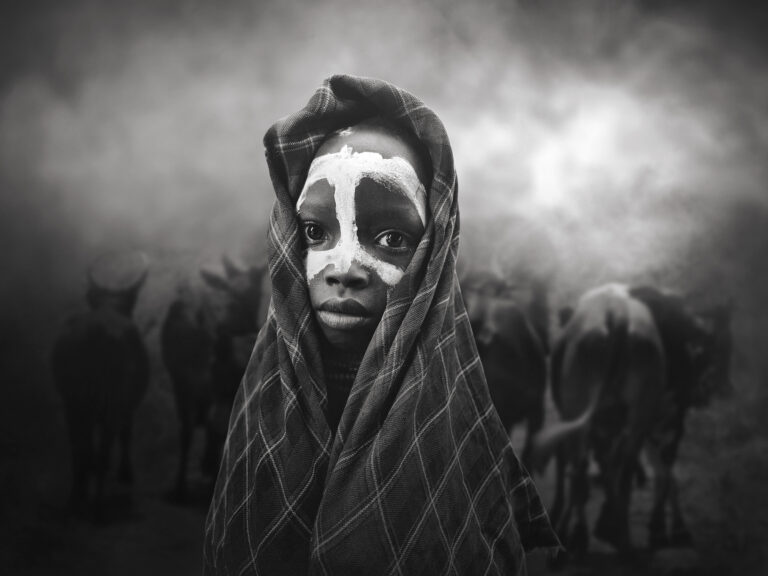
Caro boy
We’re pleased to feature Svetlin Yosifov, 2nd Place in Mobile at the Global Lens Photography Awards 2025, and also an Honorable Mention in Black & White.
In Caro boy, Yosifov creates a portrait that is at once culturally specific and deeply human. Working with the traditions of the Karo tribe in Ethiopia,
he moves beyond surface description to reveal individuality, presence, and emotional depth—turning a single face into a story that stays with the viewer.
In “Caro boy,” what first drew you to this child and this particular moment?
The first thing that drew me to the boy was his striking presence and the effortless fear in his eyes. What made the moment special was its authenticity.
The boy wasn’t posing or performing for the camera; he was simply himself in his community along the Omo River.
The face painting carries cultural meaning, but the portrait also feels deeply personal. How do you balance documenting tradition with revealing individual character?
This balance is easy to achieve if I am in the right place, because unfortunately there are places where traditions no longer exist.
I use tradition as a backdrop against which the unique human story of each portrait stands out.
Body and face painting is inherent to the Karo tribe. It is a tradition of the tribe for more than 500 years, which reveals social status as well as attracting
the opposite sex in social life.
You describe portraiture as the genre that compels you most. What did this boy’s expression communicate to you beyond the visible symbols?
The expression of this Karo boy conveyed to me a sense of calm, dignity, and inner confidence. His gaze also conveyed a childlike curiosity about the world,
which made his image very human and familiar.
Beyond the drawings on his face, what was depicted revealed his individuality — that he was not just a bearer of tradition, but a separate person with his own
character and emotions. It is this look that gives the portrait depth and transforms it from a mere cultural image into the truth.
Your work often focuses on traditions in primal and natural places. What responsibility do you feel when photographing communities with strong cultural identity?
I am drawn to remote places and tribes where traditions are still honored and passed down through the generations. Places where tradition is still alive and visible
in everyday life — communities that preserve their rituals, symbols, and connection to their history.
Mobile photography creates a very different relationship between photographer and subject than a larger camera often does. Did using a mobile device change the way this portrait was made?
Yes, using a mobile device definitely influenced the way this portrait was taken. A phone is a much more discreet and natural tool in our daily lives, which helps
people relax in front of the camera. In such a situation, the connection between the photographer and the subject becomes more immediate and less formal.
This allowed me to be closer to the moment and the person I was photographing. Instead of concentrating on the technique and equipment, I could focus on the expression,
the mood, and the brief, genuine moments that often occur spontaneously.
The image is simple, but it stays in the mind. When you are making a portrait, what matters most to you: eye contact, emotion, light, or the story behind the face?
For me, the emotion created by the face, the eyes, and the background are important. It is not necessary to have eye contact with the camera.
The eyes can tell a story without staring into the lens. In most cases, spontaneous portraits speak more and are more candid.
On the other hand, eye contact can create a strong, permanent connection between the person in the photo and the viewer.
You believe photography should do more than preserve a memory—it should tell a story strong enough to raise awareness. What do you hope viewers understand or feel when they see “Caro boy”?
This photo is my favorite, but not because it has won dozens of competitions around the world. I love it because I see an image that makes the viewer finish the story themselves.
That is what good photos are for me.
Instead of getting a ready-made explanation, viewers start asking themselves questions like: What is the boy thinking? What is his life like? What does he dream about?
In this sense, the work functions not only as a portrait, but as a small story about the human condition. Instead of being seen as an “exotic object,” the boy is presented
as a person with his own character and presence.
At best, such a photograph allows the viewer to learn something about another culture while also feeling close to the person in the frame.