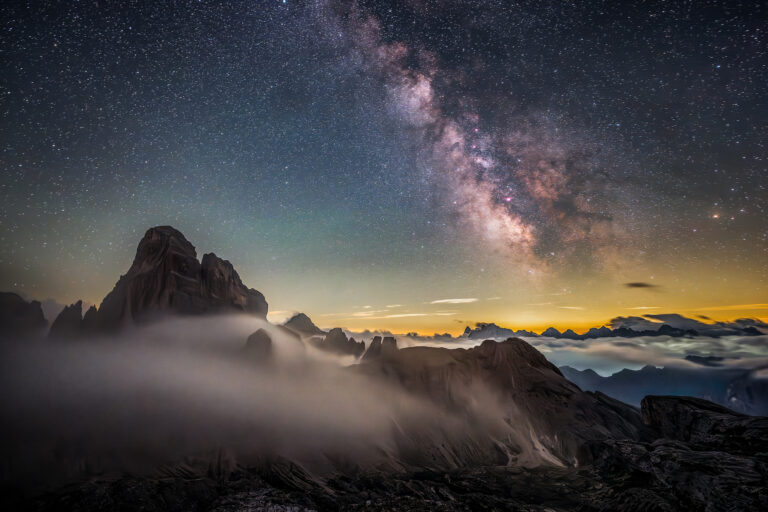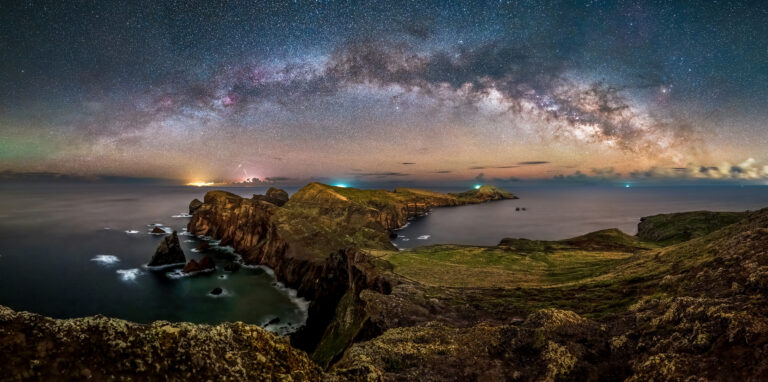
Gábor Takács — 1st Place, Travel
An interview with Gábor Takács
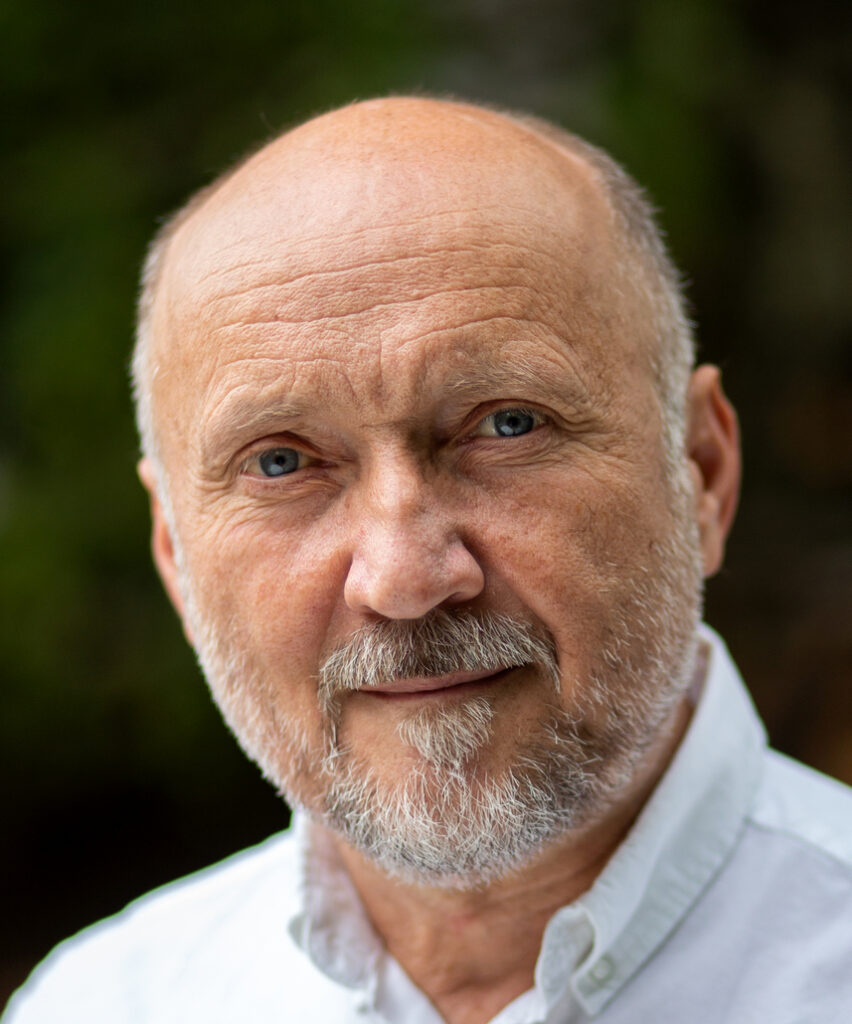
GLPA 2025 Winner Interview
Gábor Takács — 1st Place, Travel
Starry Nights in the Dolomites
We’re honored to feature Gábor Takács, winner of 1st Place in Travel at the Global Lens Photography Awards 2025, as well as an Honorable Mention in Landscape.
In Starry Nights in the Dolomites, Takács returns again and again to one of Europe’s most iconic mountain ranges, building a body of work shaped by endurance,
technical precision, and wonder. His images remind us that night landscape photography is not only about planning and skill, but about devotion to place, patience,
and the willingness to return until light, weather, and imagination finally align.
You’ve been returning to the Dolomites for around a decade. What is it about these mountains that keeps pulling you back, especially at night?
In 2014, I went on an organized trekking tour to the Dolomites for the first time. I fell in love with them immediately. I had been to the German, Austrian,
Slovenian, and French Alps before, but for me the Dolomites became the queen of the Alps.
The others also impressed me with their size, wildness, dizzying height, and majestic views, but the Dolomites, with their graceful and delicately shaped peaks,
decorated with thousands of laces, are sculptural works of art. And while elsewhere in the Alps the rocks are mostly dark grey, in the Dolomites the color of the
mountains changes dramatically depending on the time of day.
During the day the peaks shine in whitish, light grey, or creamy white. At sunrise and sunset the rocks glow in the most diverse shades of red, orange, pink, and
purple. At dusk, after the lights go out, the peaks often take on a cold, bluish, or mystical violet hue. This spectacular play of colors is due to the high magnesium
and calcium carbonate content of the rock, which reacts much more vividly to light than other, darker rock parts of the Alps.
The hike itself was very exhausting for me. With my backpack loaded with interchangeable lenses and a tripod, I had a hard time keeping up with my fellow hikers,
who were not photographers. With their small backpacks containing only a raincoat, sweater, a few sandwiches, and water, they briskly trotted along the daily hike
from valley to peak, from pass to pass, from hut to hut. So during the day I just ran after them and absorbed the scenery.
Arriving at a pre-booked hut, they kicked off their tired boots and indulged in a delicious dinner prepared in the hut’s kitchen before retiring for a rest.
For me, after a tiring day of hiking, this is when the creative period began. Instead of dinner, I was looking for a view to capture the majestic landscape in
the twilight lights until the stars shone.
More than once, I was so absorbed in admiring and photographing the combination of the huge mountains and the even bigger starry sky that it was dawn before I realized
that I hadn’t rested all night. On this first hike, I was physically exhausted, but my camera’s SD card and my soul were recharged, my imagination was fired up by what I saw,
and my bucket list was filled with the desire to see and capture familiar locations again in ideal light, as well as to discover new places.
You mention scouting locations during daytime hikes and sometimes waiting years for the right conditions. How do you know a place is worth returning to again and again?
Although I have been most motivated by astrolandscape photography for the last ten years, I am not only a night owl, I am also a fan of classic daytime landscape photography.
Since the hidden beauty and plasticity of landscapes are best revealed by the warm dawn or dusk lights and elongated shadows, during the day, when the light is less advantageous
for a landscape photographer, I hike and explore.
When I reach a point that seems interesting, I walk around the place, find the most ideal crop for me, and take a “sketch” picture. I think about what time of day it would be
better to return, and at the same time I save the coordinates of the location.
I use the PhotoPills application, with which not only the exact position of the Sun and the Moon can be planned in advance. In the case of night photos, it connects to the camera
of your mobile phone and shows how the landscape and the sky above it could look together. I can determine, down to the hour or minute, when I need to be there so that, for example,
the Milky Way is in the most advantageous place for my composition.
And why can it sometimes take years? The strong moonlight fades the view of the stars and the Milky Way. The only days and hours of the night that are suitable for photographing the
Milky Way are when the Moon is not above the horizon. And it is not certain that, due to the rotation of the Earth and the change of seasons, the Milky Way is in the ideal place at these
suitable hours, or at all, at the time of year when I am there.
I live in Hungary; 700 kilometers of travel and country borders separate me from the location of the pictures I dream of. And although many factors can be planned precisely in advance,
the weather is an exception. Despite the forecasts, the cloud cover can be very different and change quickly at a given location among the mountains. In addition to careful planning,
luck is also necessary, or, as I believe, the Creator’s blessing.
Weather in the Dolomites can be unpredictable. Can you share one moment when a long-awaited shot finally came together after years of waiting?
A good example of this is the last image of my winning series: the moonlit Monte Paterno reflected in the Piani lakes, with the constellation Orion above it on the left.
This was taken in mid-October, when the mountain huts were already closed.
During my hikes I found this shooting point on the edge of the marshy shore.
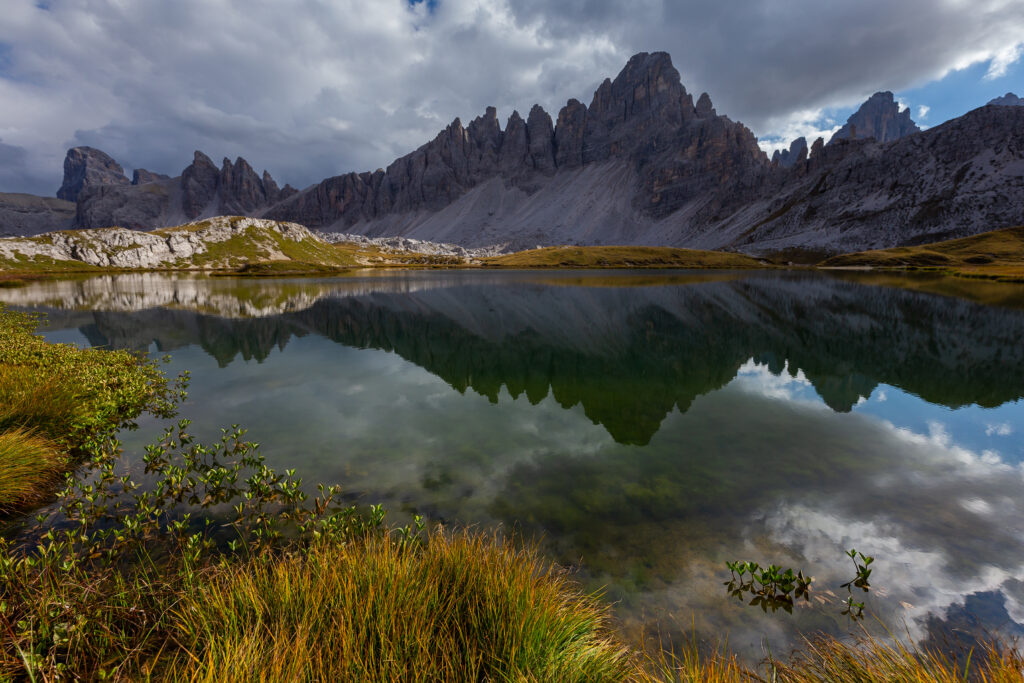
Then I returned here at a suitable dawn.
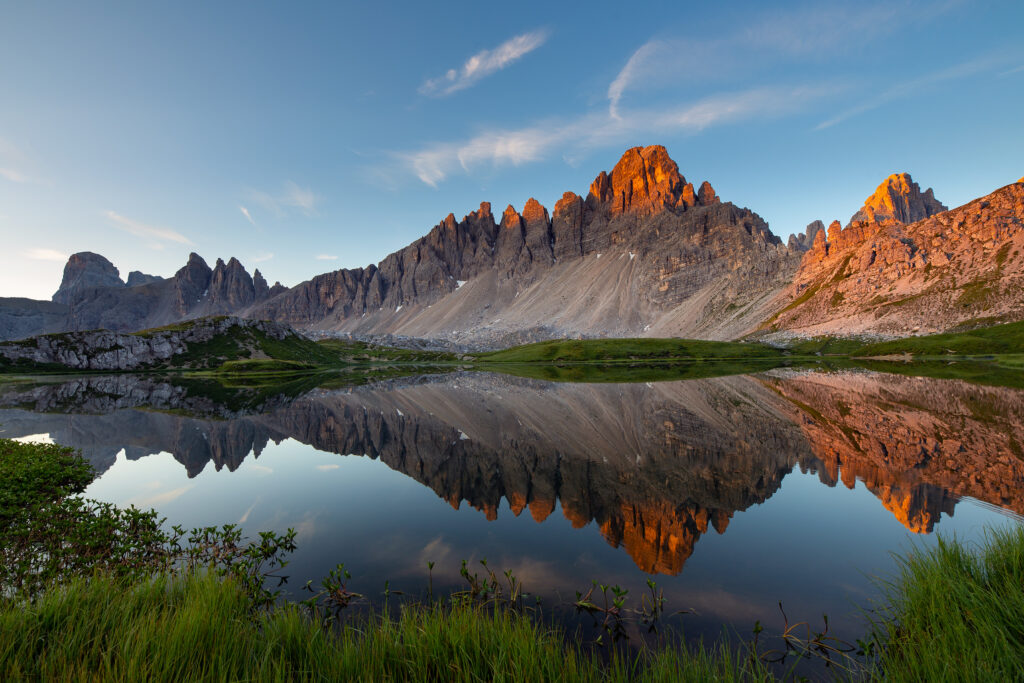
Then on a moonlit night, when the Moon was right in front of me.
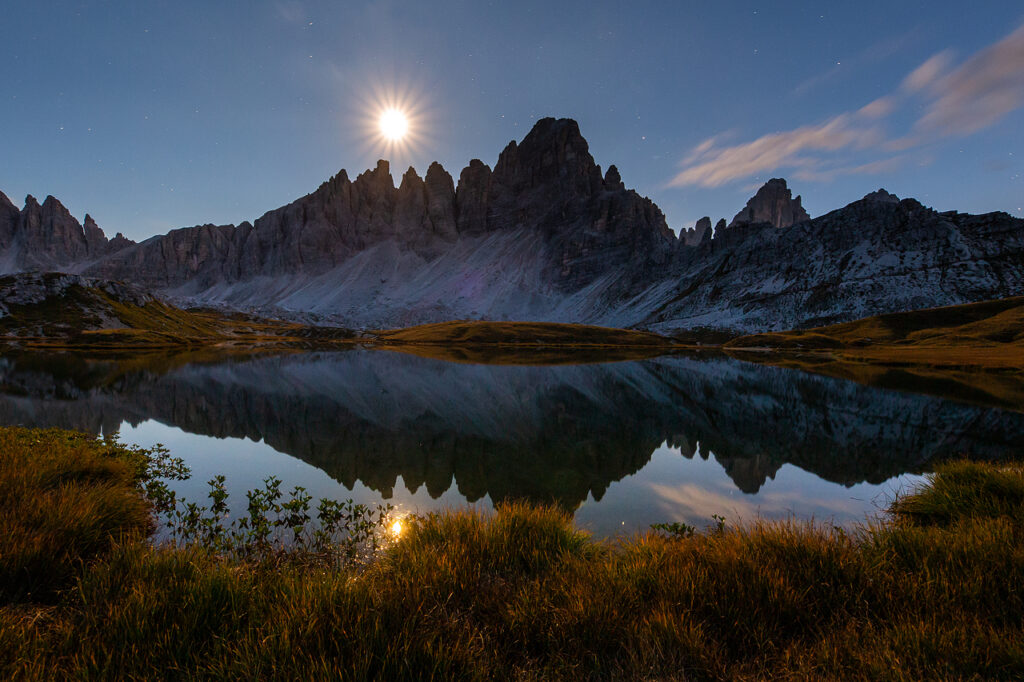
And finally, the picture from my winning series.
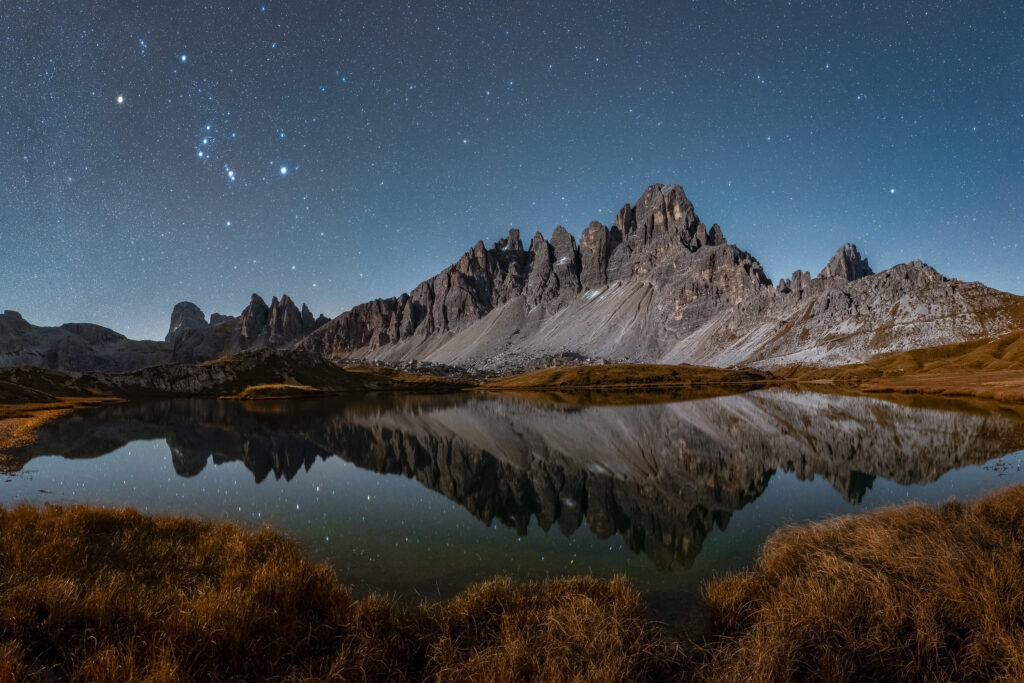
And I have another idea. Not far from this, for years I have been interested in creating a panoramic image, a combination of lakes and mountains with a shelter and a small chapel.
In my visits from dawn to dusk, I have never seen the light of the landscape as intimate as on this full moon night. The Moon is hidden behind the foamy clouds, while its warm light
illuminates the mountains.
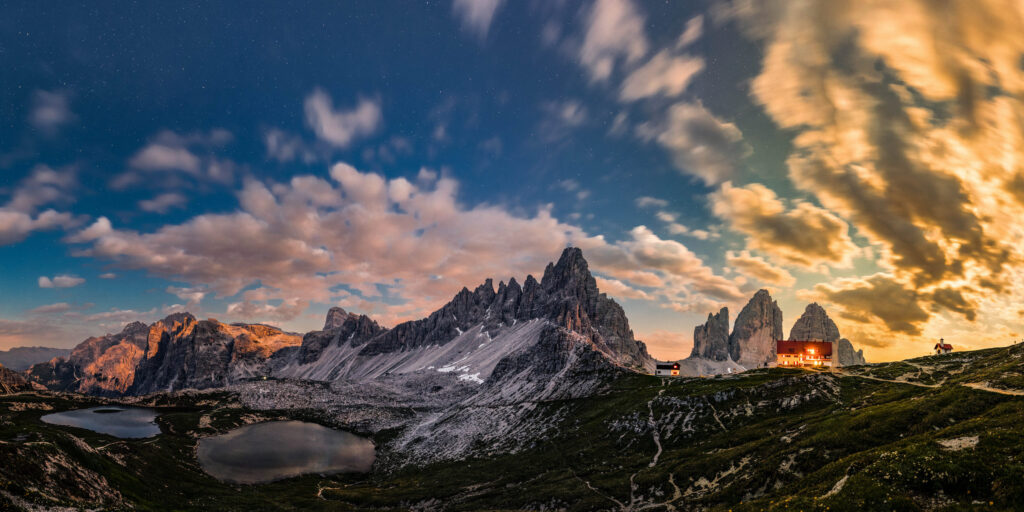
In night landscape photography, what matters most to you: the sky, the shape of the peaks, the atmosphere, or the emotional silence of the place?
All of this together. One is dwarfed by the huge mountain peaks that pierce the sky. All of this is topped off by the sight of the endless sky.
For me, what is particularly exciting and incomprehensible about night landscapes is that the landscape in front of me is the present, and the background is the endless past.
Because the light of the stars that we see set out towards us tens of thousands or hundreds of thousands of years ago. Such a night landscape contains an eternity.
Your series feels both majestic and intimate. How do you balance technical precision with the feeling of wonder that night landscapes can carry?
Astrolandscape photography is a truly technical challenge. The lens is wide open, the camera sensor is set to high ISO, a tripod that is stable even in the strong winds that are
common in the mountains, and the photographer himself are put to the ultimate test.
The little light available must be captured in a way that both the landscape and the sky, meaning the subject and the light source, are perfectly depicted, balancing the movement of
the stars and the noise caused by high ISO. However, meeting the technical requirements should not distract attention from the soul of the image, the mood and feeling that we want to convey.
What is the biggest challenge in photographing mountain landscapes at night that viewers may not realize?
To see and make visible the invisible.
During the day, we explore the landscape and the point from which the picture will be taken at night. We should be able to find our way back there safely in the dark.
The white beam of our headlamp only illuminates a narrow strip for us; everything else is pitch black. Not only do we have to be extra careful with every step we take,
it is also easy to get lost. If we go out alone at night, we should always let those staying at home know where we’re going and how long we plan to stay.
When we arrive at the location, we turn off the white lights, which ensured that we don’t get crushed. After that, it switches to red light. Red light does not hinder the eyes’
adaptation to the dark. It is not enough for transportation, but it is enough for assembling the equipment. Thus, the eyes adapt to the dark in about 30 minutes.
And yes, there is light at night. In the evening, the billions of stars in the sky act as the sun, illuminating the landscape, and the human eye also adapts to the dark.
Even if there is no moonlight, the stars shine. I can see the outlines of the mountains, the arc of the Milky Way — of course not in color, like the camera sensor.
Yes, but when we peer into the camera, we often don’t see any of this. In such cases, we have to randomly shoot, adjust where to take the picture, where to aim with the camera placed
on a stable tripod. Shooting, adjusting, shooting, adjusting until the desired composition is achieved.
And then comes the next pitfall: precise focusing on the stars. Autofocus does not work at night, and the infinity mark on the lenses is only approximate. The stars seen by a wide-angle
lens are only a few pixels in size. These tiny points should be brought into focus precisely.
The ability to achieve precise focus is affected by the health of our vision, our momentary fatigue, the tears that have gathered in our eyes due to the cold and the wind.
This can work well with a lot of practice, but even the most experienced often run into this: only at home, when looking at the image on the monitor, does it become clear that all the
planning and effort was in vain — the images are soft, the stars are not sharp, but have softened.
Having experienced this failure myself several times, I developed a unique mask with a few years of work, which is currently the only one on the market that specifically provides
astrolandscape photographers working with wide-angle and ultra-wide-angle lenses with the maximum sharpness that their lens is capable of. This device now makes the lives of thousands
of astrolandscape photographers around the world easier.
Available on my website:
www.focusonstars.com
You also received an Honorable Mention in Landscape. How does your approach change when you think of an image as “travel” versus “landscape,” if at all?
When taking landscape photos, my approach is the same. Natural landscapes that are often difficult to reach are part of a great journey.
Of course, when humans are also present in the natural landscape, either by their presence or by their work that transforms the landscape, then the emphasis shifts slightly,
and the local culture, human behavior, and emotions take on an important role.
For photographers who dream of creating strong night landscape work, what is one lesson the Dolomites have taught you that no tutorial can?
If I can see the possibilities of the moment, despite or in spite of my forethought, it can often result in images that are even better than what I dreamed.