Haeil Kwon — 3rd Place, Architecture
An interview with Haeil KWON
GLPA 2025 Winner Interview
Haeil Kwon — 3rd Place, Architecture
Space After Spectacle
We’re honored to feature Haeil Kwon, 3rd Place in Architecture at the Global Lens Photography Awards 2025.
In Space After Spectacle, Kwon examines the making of contemporary apartment culture in Korea through a sharp conceptual lens,
drawing on ideas from Guy Debord and Marc Augé to question what happens when homes become spectacle, commodities, and non-places.
The result is a body of work that is visually commanding, intellectually rigorous, and deeply relevant to the way modern cities are being built and lived.
In “Space After Spectacle,” you describe apartments as communal spaces that paradoxically produce isolation. What first led you to photograph that contradiction?
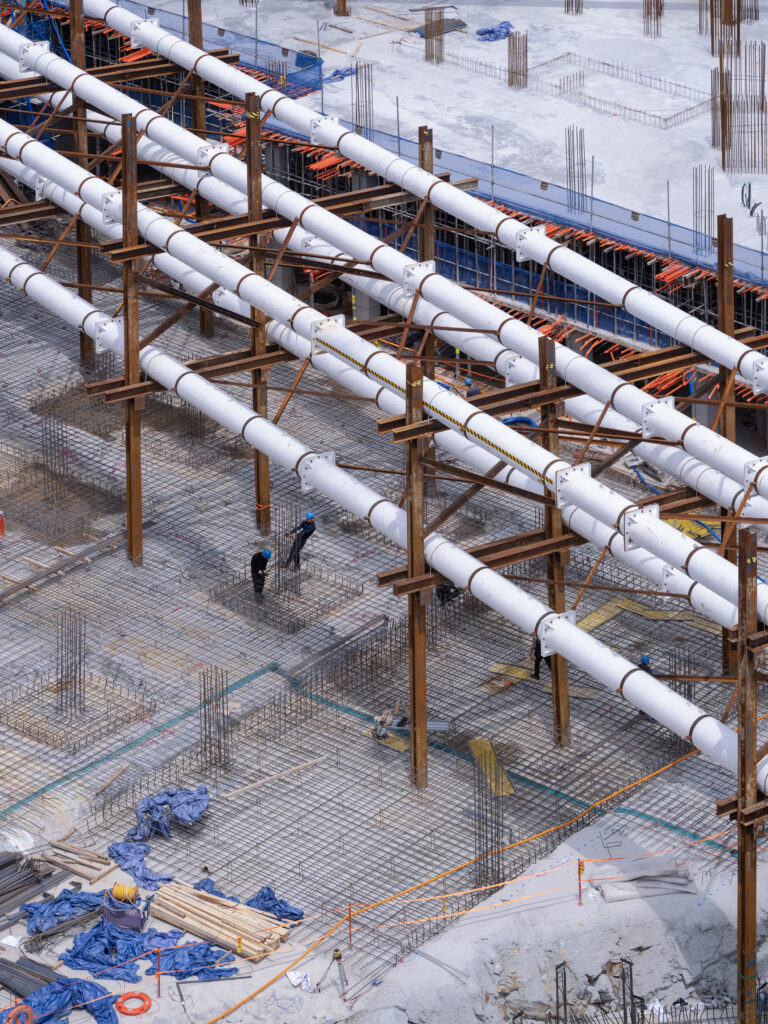
The decisive moment for this project came when I happened to look down at a massive apartment construction site from the rooftop of a high-rise building.
I have always maintained a top-down perspective in my work; from that elevated vantage point, the site appeared as a gargantuan visual sculpture—meticulously
engineered to trigger human desire. What struck me most was the strategic use of symbolic brand colors by construction companies, which dominate the site throughout
the building process. Even before these concrete giants are completed, they are already cloaked in the colors of specific capital, functioning as a “spectacle” that
stimulates ambition. I realized then that while these spaces are physically designed for thousands, their essence is a commodified system that ultimately isolates the individual.
Your work is informed by Guy Debord’s Society of the Spectacle and Marc Augé’s idea of non-places. How do those concepts shape what you look for when you enter a construction site or redevelopment zone?
When I enter a construction site, I do not see it as a place where “homes” are being built, but as a factory for the “Spectacle.” Guided by Debord’s theory,
I look for the visual apparatuses that transform a living space into a commodity—the grand scaffolding and the theatrical banners that create an illusion of a perfect future.
Simultaneously, through Marc Augé’s lens, I observe how these zones manifest as “non-places.” They are anonymous, transitional spaces characterized by a lack of historical
continuity. I search for the clinical coldness of these sites, where the unique identity of the land is erased to make way for a standardized, exchangeable environment.
The process of apartment construction in your images feels grand, fast, and almost theatrical. What does that spectacle reveal about contemporary housing culture in Korea?
The sheer speed and scale of Korean apartment construction are, in themselves, a form of performance. This “theatricality” reveals a housing culture that prioritizes efficiency
and asset value over the organic growth of human life. The grand spectacle masks the reality that we are building “machines for living” rather than “homes for being.” It reflects
a society where the demolition of the old is celebrated as progress, effectively turning our most private sphere into a public display of wealth and status.
You often focus on disappearing neighborhoods and small homes caught between redevelopment zones. What do you feel is most at risk of being lost when these spaces vanish?
What is most at risk is “human-scale memory” and the “organic texture of time.” The disappearing neighborhoods are messy and imperfect—qualities that are inherently human.
They hold the accumulated history of individual lives. When these are replaced by the monolithic uniformity of high-rise complexes, we lose the “accumulation of time” that cannot
be reconstructed. We are trading a landscape of diverse, personal narratives for a sterile, repetitive environment.
Your photographs are critical, but they also have a strong formal power. How do you balance architectural beauty with social discomfort?
This balance is a deliberate aesthetic strategy. I use “visual allure” and “formal beauty” as a hook to engage the viewer. However, this beauty mimics the seductive nature of the
“Spectacle” itself. By presenting a critique through a lens of compositional perfection, I create a tension that mirrors our reality—we are often so mesmerized by the sophisticated
aesthetics of modern urban life that we fail to see the underlying dehumanization. Once the viewer is drawn in by the beauty, they are forced to confront the cold, systemic discomfort
beneath the surface.
In these large construction environments, what visual detail tells you that a space has already stopped being a “home” and become a commodified system?
I find that evidence in the “infinite repetition of the grid” and the “erasure of human traces.” When I see hundreds of identical window frames stacked like shipping containers, or the
way the construction company’s logo is plastered on every safety net before a single brick is laid, I see a system, not a home. The “synthetic perfection” of the materials—surfaces
designed to be looked at rather than touched—confirms that the space has been fully assimilated into a commodified system.
Do you see this project primarily as documentation, social critique, or a philosophical reflection on how people now inhabit space?
I view this project as a synthesis of all three, though I would describe it most accurately as a “Visual Philosophical Reflection.” It began as documentation in 2016, but evolved into a
social critique. Ultimately, I want these images to provoke a deeper philosophical question: If we inhabit spaces designed solely for exchange and anonymity, what does that do to our humanity?
What does this GLPA recognition mean to you, and what questions about urban life or housing are you most compelled to continue exploring next?
This recognition validates that the specific urban conditions of Korea resonate as a universal story of modern alienation. Moving forward, I am compelled to explore the “ghostly” quality
of these new spaces. I want to ask: “Is it possible to reclaim a sense of ‘place’ within a ‘non-place’?” I will continue to look behind the curtain of the urban spectacle, searching for the
flickering remains of our humanity.